Pope calls on Christians to forgive and rebuild amid ruins of churches in Iraq

Pope Francis has called on Iraq’s Christians to forgive the injustices committed against them by Islamic extremists.

The call came as he visited the wrecked shells of churches and met ecstatic crowds in the community’s historic heartland, which was nearly erased by the so-called Islamic State group’s horrific reign.

At each stop in northern Iraq the remnants of its Christian population turned out, jubilant and decked out in colourful dress, though heavy security prevented Francis from plunging into the crowd as he would normally do.

Nonetheless, they seemed simply overjoyed that they had not been forgotten. It was a sign of the desperation for support among an ancient community uncertain whether it can hold on.

Traditionally Christian towns dotting the Nineveh Plains of the north were emptied as Christians – as well as many Muslims – fled the Islamic State group’s onslaught in 2014. Only a few have returned to their homes since the defeat of IS in Iraq, which was declared four years ago, and the rest remain scattered elsewhere in Iraq or abroad.

Bells rang out in the town of Qaraqosh as the Pope arrived. Speaking to a packed Church of the Immaculate Conception, Francis said “forgiveness” is a key word for Christians.

“The road to a full recovery may still be long, but I ask you, please, not to grow discouraged. What is needed is the ability to forgive, but also the courage not to give up.”

The Qaraqosh church has been extensively renovated after being vandalised by IS militants during their takeover of the town, making it a symbol of recovery efforts.

For the Vatican, the continued presence of Christians in Iraq is vital to keeping alive faith communities that have existed there since the time of Christ. The population has dwindled from around 1.5 million before the 2003 US-led invasion that plunged the country into chaos to just a few hundred thousand today.

Francis’s visit to Iraq aimed to encourage them to stay and help rebuild the country and restore what he called its “intricately designed carpet” of faith and ethnic groups.

In striking images earlier on Sunday, Francis, dressed in white, took to a red carpet stage in a square in the north’s main city, Mosul, surrounded by the grey hollowed-out shells of four churches, nearly destroyed in the war to oust the Islamic State group from the city.

It was a scene that would have been unimaginable years earlier. Mosul, Iraq’s second largest city, was at the heart of the IS so-called “caliphate” and witnessed the worst of the group’s rule inflicted on Muslims, Christians and others, including beheadings and mass killings.

“How cruel it is that this country, the cradle of civilisation, should have been afflicted by so barbarous a blow,” Francis said, “with ancient places of worship destroyed and many thousands of people – Muslims, Christians, Yazidis – who were cruelly annihilated by terrorism – and others forcibly displaced or killed.”

He deviated from his prepared speech to address the plight of Iraq’s Yazidi minority, which was subjected to mass killings, abductions and sexual slavery at the hands of IS.

“Today, however, we reaffirm our conviction that fraternity is more durable than fratricide, that hope is more powerful than hatred, that peace more powerful than war,” he said.

The square where he spoke is home to four different churches – Syriac Catholic, Armenian-Orthodox, Syriac Orthodox and Chaldean – each left in ruins.

IS inflicted atrocities against all communities, including Muslims, during its three-year rule across much of northern and western Iraq. But the Christian minority was hit especially hard.

The militants forced them to choose among conversion, death or the payment of a special tax for non-Muslims. Thousands fled, leaving behind homes and churches that were destroyed or commandeered by the extremists.

Mosul, Iraq’s second largest city, became IS’s bureaucratic and financial backbone. It was from Mosul’s al-Nuri mosque that then-IS leader Abu Bakr al-Baghdadi made his only public appearance when he gave a Friday sermon calling on all Muslims to follow him as “caliph”.

It took a ferocious nine-month battle to finally free the city in July 2017, during which between 9,000 and 11,000 civilians were killed, according to an AP investigation at the time. Al-Baghdadi was killed in a US raid in Syria in 2019.

The war left a swath of destruction across Mosul and the north, and many Iraqis have been left on their own to rebuild amid a long financial crisis.

The Rev Raed Kallo was among the few Christians who returned to Mosul after IS was defeated.

“My Muslim brothers received me after the liberation of the city with great hospitality and love,” he said on stage before the pontiff.

Before IS, he had a parish of 500 Christian families. Most emigrated abroad, and now only 70 families remain, he said. “But today I live among two million Muslims who call me their Father Raed,” he said.

Gutayba Aagha, the Muslim head of the Independent Social and Cultural Council for the Families of Mosul, encouraged other Christians to return.

“In the name of the council I invite all our Christian brothers to return to this, their city, their properties and their businesses,” he said.

Throughout his four-day visit, Francis has delivered a message of inter-religious tolerance and fraternity to Muslim leaders, including in an historic meeting on Saturday with Iraq’s top Shiite cleric, Grand Ayatollah Ali al-Sistani.

At Qaraqosh, Francis urged its residents to continue to dream, and forgive.

“Forgiveness is necessary to remain in love, to remain Christian,” he said.

Public health experts had expressed concerns ahead of the trip that large gatherings could serve as super-spreader events for coronavirus in a country suffering from a worsening outbreak where few have been vaccinated.

Later, thousands of people filled a sports stadium in the northern city of Irbil for Francis’ final event in his visit to Iraq: an open-air mass featuring a statue of the Virgin Mary that was restored after Islamic militants chopped of the head and hands.

The statue was transported from the church in Keramlis, a Christian village on the Nineveh Plains, to a place of honour on the altar for Sunday’s mass.

Keramlis, an ancient Assyrian town less than 18 miles from Mosul, fell to IS in August 2014, two months after the extremists took Mosul and its surrounding areas, sending most inhabitants fleeing. In Keramlis, they destroyed the interior of St Adday church and decapitated the statue of the Madonna.


Read more: Pope says it is wrong to identify Islam with violence

The post Pope calls on Christians to forgive and rebuild amid ruins of churches in Iraq appeared first on Faith Matters.

Categories: Forgiveness, Iraqi Christians, Islamic State, News, Pope Francis
Pope urges Iraq to embrace its Christians on historic visit

Pope Francis has urged Iraqis to treat their Christian brothers as a precious resource to protect, not an “obstacle” to eliminate, as he opened the first papal visit to Iraq with a plea for tolerance and fraternity among Christians and Muslims.

Francis brushed aside the coronavirus pandemic and security concerns to resume his globe-trotting papacy after a year-long gap under Covid-19 lockdown in Vatican City.

His primary aim over the weekend is to encourage Iraq’s dwindling number of Christians, who were violently persecuted by the so-called Islamic State group and still face discrimination by the Shiite majority, to stay and help rebuild the country devastated by wars and strife.

“Only if we learn to look beyond our differences and see each other as members of the same human family will we be able to begin an effective process of rebuilding and leave to future generations a better, more just and more humane world,” Francis told Iraqi authorities in his welcoming address.

The 84-year-old donned a facemask during the flight from Rome and throughout all his protocol visits, as did his hosts, but the masks came off when the leaders sat down to talk, and social distancing and other health measures appeared lax at the airport and on the streets of Baghdad, despite the country’s worsening Covid-19 outbreak.

Francis was transported around Baghdad in what Iraqi security officials said was an armoured black BMW, flanked by rows of police on siren-blaring motorcycles. It was believed to be the first time Francis had used a bulletproof car.

Iraqis seemed keen to welcome Francis and the global attention his visit was bringing, with some lining the road to cheer his motorcade and banners and posters hanging high in central Baghdad depicting Francis with the slogan “We are all Brothers”.

In central Tahrir Square, a mock tree was erected emblazoned with the Vatican emblem, while Iraqi and Vatican flags lined empty streets.

The government is eager to show off the relative security it has achieved after years of wars and its defeat of the IS insurgency.

Francis’s first main event was a pomp-filled courtesy visit with President Barham Salih at the Baghdad palace inside the heavily fortified Green Zone.

Afterwards, Francis told Mr Salih and other Iraqi officials that Christians and other minorities should not be considered second-class citizens in Iraq but deserve to have the same rights and protections as the Shiite Muslim majority.

“The religious, cultural and ethnic diversity that has been a hallmark of Iraqi society for millennia is a precious resource on which to draw, not an obstacle to eliminate,” he said.

“Iraq today is called to show everyone, especially in the Middle East, that diversity, instead of giving rise to conflict, should lead to harmonious co-operation in the life of society.”

Mr Salih echoed his call and praised Francis for coming to make it in person in Iraq despite the pandemic and security concerns.

“The East cannot be imagined without Christians,” he said. “The continued migration of Christians from the countries of the east will have dire consequences for the ability of the people from the same region to live together.”

Christians once constituted a sizeable minority in Iraq, estimated at around 1.4 million, but their numbers began to fall after the 2003 US-led invasion that ousted Saddam Hussein opened a wave of instability in which militants repeatedly targeted Christians.

They received a further blow when IS militants in 2014 swept through northern Iraq, including traditionally Christian towns across the Nineveh plains, some of which date from the time of Christ.

Their extremist version of Islam forced residents to flee to the neighbouring Kurdish region or further afield.

Few have returned — estimates suggest there are fewer than 300,000 Christians still in Iraq and many of those remain displaced from their homes.


Read more: Fearful Christmas in Baghdad after attacks on Christians

The post Pope urges Iraq to embrace its Christians on historic visit appeared first on Faith Matters.

Categories: Christian Persecution, Christians, Green Zone, Iraq, News, Persecution, Pope

‘Fifth of terror prisoners are right-wing extremists’

One in five people behind bars for terror offences in Britain last year were right-wing extremists – the highest proportion since records began.

A total of 42 out of 209 prisoners in 2020 (20%) were classed as holding “extreme right-wing” views, up from 18% the previous year (41 out of 231), Home Office figures show.

Records on prisoner ideology began in 2013, when the proportion stood at 6%.

This halved to 3% in the following two years but has risen year on year ever since.

While the “vast majority” (75%) are still classed as having Islamist extremist views, the number of inmates recorded as holding this ideology fell from 177 to 156 in the 12-month period.


Read more: Young teenagers being drawn in by right-wing extremism


The figures, which count convicted offenders and those being held on remand, also recorded 11 inmates who were not classified as holding a specific ideology, down from 13 a year earlier.

There were 31 convicted terrorists released from jail as well as 11 suspects who had been held in custody but not sentenced in the year to September, according to the data. Figures to December are not yet available.

The number of arrests for terrorism-related activity fell by 34%, from 282 down to 185, the lowest in nine years.

The figures came as it emerged that counter-terror police and UK intelligence services have foiled three terror attacks since the coronavirus pandemic began.

The fall in arrests may reflect the general reduction in crime during the pandemic, the effect of which was “most marked” between April and June amid national lockdowns and restrictions on movement, the Home Office report said.

Of these arrests, 56 (30%) resulted in a charge, 48 of which were terror-related.

Some 73 suspects (39%) were released on bail or released under investigation, meaning they were not subject to any restrictions while police inquiries continued.

A further 13 (7%) faced other action such as receiving a caution or being recalled to prison, while 40 suspects (22%) were released without charge.

The post ‘Fifth of terror prisoners are right-wing extremists’ appeared first on Faith Matters.

Categories: Convicted terrorists, News, One fifth, Right wing extremism, Right Wing Extremists, Terror Prisoners

Three female media workers shot dead in eastern Afghanistan

Three women who worked for a local radio and TV station in eastern Afghanistan have been shot dead in separate attacks, the news editor of the station said.

Shokrullah Pasoon, of Enikass Radio and TV in Jalalabad, said one of the women, Mursal Wahidi, was walking home when gunmen opened fire, according to witnesses.

The other two, identified only as Shahnaz and Sadia, were shot in a separate incident, also walking home from work. Two other people, apparently passers-by, were wounded in the attack.

Afghanistan is one of the most dangerous countries in the world for media workers, with 15 killed in the last six months.

The three women dubbed popular and often emotion-laden dramas from Turkey and India into Afghanistan’s local languages of Dari and Pashtu, said Pasoon.

No one claimed the latest killings, but in December an affiliate of the so-called Islamic State group, headquartered in eastern Afghanistan, claimed the killing of another female Enikass employee, Malala Maiwand.

Taliban spokesman Zabihullah Mujahid denied any involvement in the killings. In a statement, President Ashraf Ghani condemned the murders, saying “attacks on innocent compatriots, especially women, are contrary to the teachings of Islam, Afghan culture and the spirit of peace”.

The killings are part of a larger spike in targeted killings in Afghanistan in the past year coinciding with the signing of a peace deal between the US and the Taliban in February 2020.

The Taliban have denied involvement in most of the targeted killings. The Taliban and the government blame each other for staging the attacks to discredit the peace deal or win greater concessions.

The Biden administration is reviewing the deal which calls for the withdrawal of US and Nato troops by May 1. Officials say no decision has been made.

Enikass Radio and TV is a privately owned outlet that broadcasts “news, various political, social, Islamic, educational, satirical and engaging programmes and standard dubbing of serials and movies for the people of Afghanistan”, according to its website.

The Afghan Journalists Safety Committee issued a statement condemning the killings and criticising government investigations of previous killings of journalists, saying they were “not satisfactory at all, something that needs to be changed”.

The Vienna-headquartered International Press Institute called the killings an “unspeakable act”.

In a statement, deputy director Scott Griffen called on the Afghan government to find and apprehend the culprits, adding: “The only way to stop the spread of violence against journalists is to break the cycle of impunity, ensuring that no one who attacks or kills a journalist or media worker can get away with it.”

The post Three female media workers shot dead in eastern Afghanistan appeared first on Faith Matters.

Categories: Afghan Taliban, Eastern Afghanistan, News, Taliban, Three women

Terror accused ‘made pro-IS posts for lockdown thrill’

An aspiring rapper accused of plotting a terror attack has told jurors he made pro-Islamic State comments online for a “thrill” in lockdown.

Sahayb Abu, 27, allegedly bought an 18in sword, knife, body armour, balaclavas and a hat in preparation for a strike last summer.

He also discussed guns with an undercover police officer he met through an IS supporters’ Telegram chat group, it is claimed.

Giving evidence at the Old Bailey, the convicted burglar claimed he had an “epiphany” upon his release from prison in March last year.

He said he made numerous searches for IS online for news of his half-brothers Wail and Suleyman Aweys, who are believed to have died in Syria in 2016.

Cross-examining Abu on Monday, prosecutor John McGuinness QC said: “You say you were not radicalised while you were in prison.

“You told the police in your interview that the memory of what happened to Suleyman and Wail haunts you to the present day.

“You told police that your view was Isis needed to answer for your brothers.”

Abu agreed he had a grudge against IS and “would not care” if the terror group was bombed to bits.

He told jurors he was no Mother Teresa or Dalai Lama, and “pro-violence” online posts were just “trolling”.

Mr McGuinness said: “How did that fit in with the new man leaving prison?”

Abu said: “This happened during lockdown. Nothing to do. The phone became a kind of portal. Being a troll.”

The prosecutor asked Abu about one post on Islam being a religion of “war”.

He said: “That post could have been posted by somebody who believes in the ideas of IS, do you agree? And those are your words.

“Bearing in mind the personal tragedy that had befallen your family because of the activities of IS, why post something like that?”

Abu replied: “Because it would bring a thrill to my life. I know it’s sad. I know it’s pathetic.”

Mr McGuinness asked: “Didn’t you think, ‘this is exactly the sort of thing that caused me to lose two of my brothers’? You chose to make those words pro-IS. It’s IS sentiment.

“Didn’t those words choke in your mouth as you were typing?

“Or the other explanation is that these posts represent the way that you felt and thought at the time.”

Abu replied: “It was just quarantine. I became pathetic. I’m sorry. I apologise.”

Mr McGuinness went on: “I’m suggesting you did mean these words at the time.

“If you were really telling the jury the truth about IS and the effect the death of your two brothers had on you, you would not have made posts like that.

“You did what your brothers did, you joined them. You became an IS supporter.”

Abu replied: “No, I did not support them at all. I wanted to do good things in my life.”

Abu, of Dagenham in Essex, has denied preparing an act of terrorism before his arrest in July last year.

His brother Muhamed Abu, 32, of Norwood, south London, has pleaded not guilty to failing to disclose information about acts of terrorism.


Read more: Rapping Jihadi Bought 18 Inch Sword Amid Lockdown

The post Terror accused ‘made pro-IS posts for lockdown thrill’ appeared first on Faith Matters.

Categories: 18 inch sword, Islamic State, Lockdown, News, Rapper, Sahayb Abu, Telegram, Telegram chat group, Terror Accused

Exclusive: Tomasz Greniuch & the Institute of National Remembrance (IPN) in Poland

The recent resignation of Tomasz Greniuch raises fundamental questions about how one of the most critically important institutions in Poland, the Institute of National Remembrance (IPN), carries out its due diligence of potential staff and why it did not intervene sooner, as Greniuch’s links to the far-right are no secret.

As our investigation reveals, Greniuch’s links to the far-right, ultranationalist National Radical Camp (ONR) run as late as 2018.

Jewish and anti-racist groups raised their concerns, with some calling for his sacking. Now, two weeks later, his tenure ends not by firing but resignation.  What due diligence did the IPN carry out? We stress that none of Greniuch’s activities was a secret, found openly on various blogs, social media, and newspapers, including information he openly shared.

Greniuch offered a public apology, published in English on the IPN website.

Faith Matters details its original investigation below, having updated the story to reflect the above.

The appointment of a former far-right activist to a local branch of the IPN has caused shock across Poland, with one major anti-racism organisation calling for his resignation.

The appointment of Tomasz Greniuch, published in a press release on February 9, was combative, insisting that Greniuch had ‘apologised’ for his ‘past mistakes’ made in his ‘youth’.

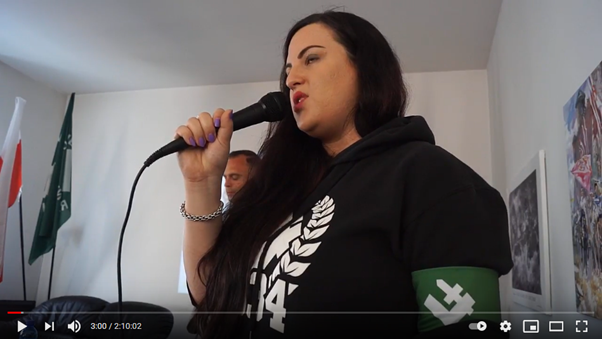
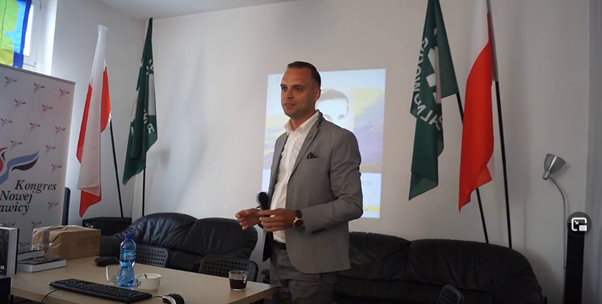
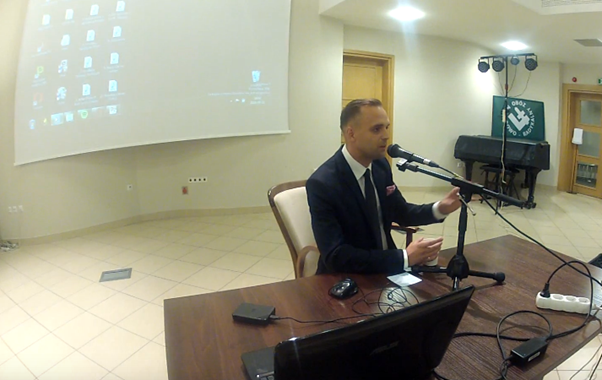
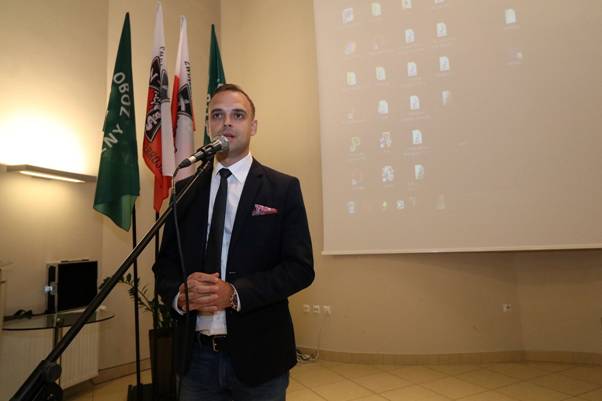
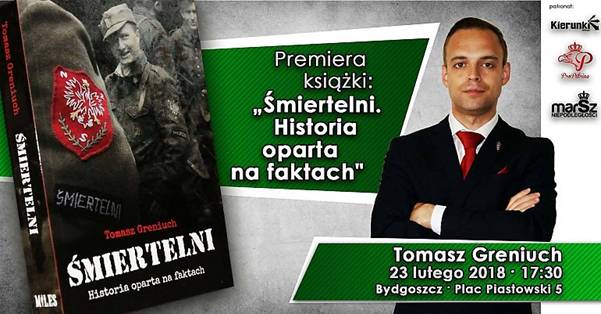
Faith Matters, however, can reveal the links to the far-right are more recent, as three speaking events in 2018 had the sponsorship of, or included Mr Greniuch speaking in front of the flags of the ultranationalist, neo-fascist National Radical Camp (ONR), having founded a local branch in Opole.

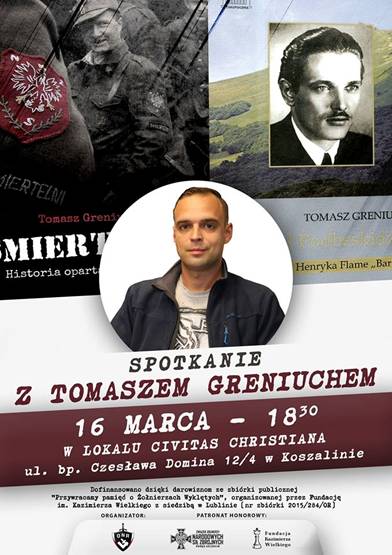
On March 16, 2018, Civitas Christiania listed Greniuch as their keynote speaker in an event sponsored by the ONR (their logo appears on the official promotional poster).


Mr Greniuch promoted the Facebook event (the text of which referenced the ONR) on a promotional page for his book Śmiertelni – Historia oparta na faktach.

The second speaking event, uploaded to YouTube on May 21, 2018, features an introduction given by a woman wearing the ONR armband, and throughout the discussion, the ONR flags appear on either side of Greniuch.

The third event, dated (per the upload on YouTube), as of September 22, 2018, featured Greniuch and was co-sponsored by a local ONR chapter (their banners and flags appear in the background throughout).

Promotional materials for another speaking event from Greniuch in February 2018 included sponsorship from the nationalist clothing brand ProPatriae. The owner of this clothing brand, Jakub Sadowski, had links to the ONR leadership, according to Oko Press.

In 2016, ProPatriae publicly thanked Greniuch for wearing their clothing on Facebook.

Other sponsors included the website Kierunki (which has retweeted ONR accounts and Twitter and gives a platform for their propaganda).

The final sponsor is Marsz Niepodległości – which organises the Independence Day marches. Its founder, Robert Bąkiewicz, was described as being an ‘important’ member of the ONR.

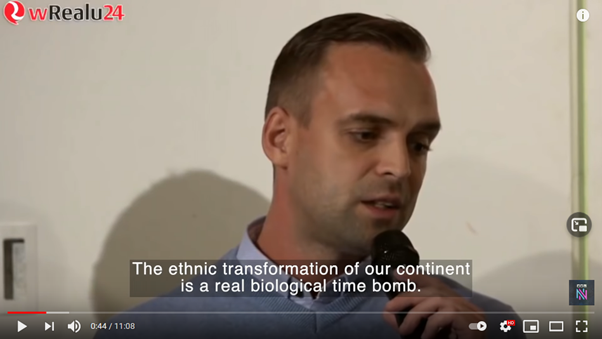
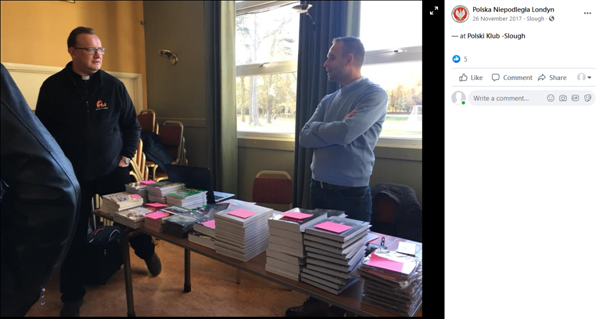
Away from far-right-sponsored events and indeed activities within Poland, as in late 2017, Greniuch spoke at the now-infamous Slough book fare event, profiled by BBC Newsnight a year later, following revelations that funds from the Polish Embassy went towards the event.

The full Newsnight investigation includes quotes from Greniuch (but does not name him). One such quote includes reference to “ethnic transformation” being “a real biological time bomb.”

Credit: BBC Newsnight

Other photos of Greniuch at the Slough event appeared on subsequent social media posts.

Various reports about Greniuch and the ONR have appeared over the years in the Polish-language media.

Nor has he escaped the attention of the English-language media either. In November 2019, the Jewish Telegraph Agency reported his appointment within the Opole branch of the IPN.

Ronald S. Lauder, President of the World Jewish Congress and Chairman of the Auschwitz-Birkenau Memorial Foundation, discussed Greniuch’s appointment in a broader article which began: “I am deeply concerned for Poland. Something is changing, and I’m afraid a country I care about deeply is moving in a very dangerous direction.”

Both Notes from Poland and Polish News report that Greniuch is “mentioned as one of the originators of the first nationalist demonstration on the occasion of Independence Day in Warsaw in 2006.”

The vice-president of Wroclaw, Sebastian Lorenc, condemned the appointment on Facebook. The anger in Wroclaw has not gone away either, with protests and even a resignation occurring.

Other politicians called for his resignation.

On Twitter, the Israeli Embassy spoke of their ‘surprise’ at the appointment, urging Greniuch to visit the Auschwitz museum.

The anti-racism organisation Never Again said: “The Institute of National Memory is one of the most important and powerful institutions in Poland. The nomination of Tomasz Greniuch to one of its key positions is shocking and disgusting. It illustrates the current breakdown of democratic values in Polish society and the strength of far-right historical revisionism and Holocaust distortion. It spits on the graves of the victims of fascism. We call for his immediate dismissal.”

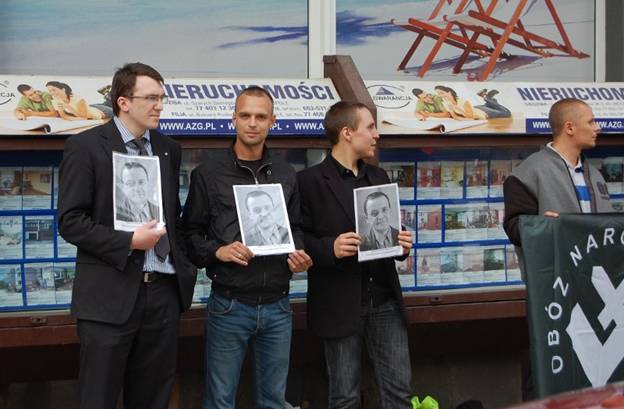
Faith Matters investigation of Greniuch’s historic ONR agitations in Opole included a notorious public eulogy of the convicted Holocaust denier Dariusz Ratajczaj in 2012.


Read more: Neo Fascist ONR, Oboz Naradowo-Radykalny, Offshoot in Manchester

The post Exclusive: Tomasz Greniuch & the Institute of National Remembrance (IPN) in Poland appeared first on Faith Matters.

Categories: Anti-Racist groups, Institute of National Remembrance, IPN, National Radical Camp, ONR, Opinions, Opole, Tomasz Greniuch

Member of banned Islamist group jailed for breaching terror prevention order

A terror suspect who cut off his electronic tag before taking a taxi to London has been jailed for more than three years.

The man, who can only be identified as LF, is a senior leader of the banned extremist group Al-Muhajiroun (ALM).

He was sentenced at the Old Bailey on Monday after pleading guilty last week to six counts of breaching a Tpim (Terrorism Prevention and Investigation Measures) order.

Tpim notices allow the authorities to monitor suspected terrorists who are not subject to criminal charges.

LF was first made subject to a two-year Tpim in October 2016 and was sentenced to two years imprisonment, suspended for two years, in May 2019 after he was convicted of breaching the conditions.

Home Secretary Priti Patel imposed a second Tpim in November 2019 because he had continued to engage in terrorism-related activity, including acting for the benefit of ALM, possessing Islamist extremist material and encouraging terrorism.

“LF met with other ALM members in London and elsewhere,” said prosecutor Kate Wilkinson. “LF twice hosted ALM meetings in his own home.”

The court heard that LF obtained an unauthorised “burner” mobile phone and £90 in cash to pay for a taxi to London in the early hours of September 15 last year after removing his electronic tag.

When police forced entry to his flat, it smelled strongly of smoke and it appeared that items, including paper, had been burnt.

LF was arrested on the morning of September 16 outside a supermarket in south-east London after calling his solicitors, who told police where to find him.

The court heard that checks at UK ports to make sure he did not flee the country caused nine-hour tailbacks for travellers.

Judge Anthony Leonard QC jailed LF for three years and two months, including concurrent sentences of two years and four months for the Tpim breaches and a 10-month prison term for breaching his suspended sentence.

“The Secretary of State was right to decide you were a senior leader in ALM, having a leading role in communications, including encouraging others to travel to Islamic State-controlled territory, and logistics,” he said.

“You are not suspected of personally carrying out terrorist attacks in this country.”

The judge said LF’s fear of his suspended sentence being activated after a probation officer upgraded his risk from “serious” to “very serious” had acted as the “catalyst” to him absconding.

“Fortunately, you came to your senses and probably your best mitigation is that you arranged to give yourself up on September 16,” he told LF, who was appearing by video-link from Frankland Prison in Durham.

Catherine Oborne, defending, said an assessment by the Home Secretary found the breach did not pose a risk to national security.

“The intention was not to engage in terrorist activity or criminal activity,” she said.

“He recognises what he did was a mistake and that he intends to have a better attitude to the order going forward.”

The post Member of banned Islamist group jailed for breaching terror prevention order appeared first on Faith Matters.

Categories: Al-Muhajiroun, News, terrorism, TPIM

Raab calls for UN to respond to ‘appalling’ human rights violations in China

The Foreign Secretary has placed diplomatic pressure on the United Nations to respond to China’s “appalling treatment” of the Uighur Muslims and people in Hong Kong.

Addressing the UN Human Rights Council on Monday, Dominic Raab said “no-one can ignore the evidence any more” of a deteriorating human rights situation in China and called for international action.

It comes amid heightened tensions between Britain and China after Beijing banned BBC World News in retaliation after broadcast regulator Ofcom stripped state TV channel China Global Television Network of its UK broadcasting licence.

The UK last year also banned technology giant Huawei from being used in the country’s 5G communications network out of fears it could be used by the Chinese government to spy on Britain.

In his online speech, Mr Raab said people’s rights in Hong Kong are being “systematically violated” and that the national security law is a “clear breach of the Sino-British Joint Declaration” that is having a “chilling effect on personal freedoms”.

“Free and fair legislative elections must take place, with a range of opposition voices allowed to take part,” he urged.

The Cabinet minister criticised the continued restricted access to Tibet before turning his attention to the “systematic” human rights violations in Xinjiang.

He told council members the treatment of Uighur Muslims and other minorities in the region was “beyond the pale”.

The tone of Mr Raab’s speech was in stark contrast to remarks allegedly made by the Prime Minister earlier this month.

Boris Johnson, according to The Guardian, is said to have told a Downing Street roundtable with Chinese businesses that he was “fervently Sinophile” and determined to improve ties “whatever the occasional political difficulties”.

But Number 10 looked to stamp out talk of a rift between the Conservative Party leader and the Foreign Secretary on Chinese relations, with the Prime Minister’s official spokesman telling reporters Mr Johnson had been “outspoken in his condemnation” of human rights abuses in Xinjiang and Hong Kong.

During his UN speech, the Foreign Secretary said: “We see almost daily reports now that shine a new light on China’s systematic human rights violations perpetrated against Uighur Muslims and other minorities in Xinjiang.

“The situation in Xinjiang is beyond the pale.

“The reported abuses – which include torture, forced labour and forced sterilisation of women – are extreme and they are extensive. They are taking place on an industrial scale.”

Mr Raab used his eight-minute address to call for a UN motion to be passed to allow investigators into Xinjiang.

He said the Government had already taken action domestically by putting in place measures that ensure no company profiting from forced labour in Xinjiang can do business in the UK.

“It must be our collective duty to ensure this does not go unanswered – UN mechanisms must respond,” he continued.

“The UN High Commissioner for Human Rights, or another independent fact-finding expert, must – and I repeat, must – be given urgent and unfettered access to Xinjiang.

“If members of this Human Rights Council are to live up to our responsibilities, there must be a resolution which secures this access.”

China has defended the presence of “re-education” camps in Xinjiang, saying they aim only to promote economic and social development in the region and to stamp out radicalism.

Mr Raab also voiced concerns about the military coup in Myanmar and the treatment of opposition leader Alexei Navalny in Russia.


Read More: Foreign Secretary Urges To Let Human Rights Commissioner Visit Xinjiang

The post Raab calls for UN to respond to ‘appalling’ human rights violations in China appeared first on Faith Matters.

Categories: Dominic Raab, human rights, News, Uighur Muslims, United Nations

Two Christians sought by police in Pakistan on ‘blasphemy’ charges

Pakistan’s police said they were seeking arrest of two Christian men in the eastern city of Lahore on charges they allegedly used insulting remarks against Islam’s holy book and its Prophet Mohammed.

The case against the two men was registered last Saturday on the complaint of a Muslim local resident Haroon Ahmed, said Muratab Ali, a police investigator, who said the accused persons had yet to be arrested.

He provided no further details and only said they were still investigating to determine whether the two minority Christians made derogatory remarks about the Koran and Islam’s Prophet during a discussion on religion.

Under Pakistan’s blasphemy laws, anyone accused of insulting Islam or other religious figures can be sentenced to death if found guilty.

While authorities have yet to carry out a death sentence for blasphemy, just the accusation of blasphemy can cause riots in Pakistan.

According to domestic and international human rights groups, blasphemy allegations in Pakistan have often been used to intimidate religious minorities and to settle personal scores.

A Punjab governor was killed by his own guard in 2011 after he defended a Christian woman, Aasia Bibi, who was accused of blasphemy.

She was acquitted after spending eight years on death row and left Pakistan for Canada to join her family after receiving threats.

The post Two Christians sought by police in Pakistan on ‘blasphemy’ charges appeared first on Faith Matters.

Categories: Blasphemy, Christian men, News, Pakistan, Prophet Muhammad

Suspected Arena bomber groomer refuses disclosure of psychiatric reports

A jailed Islamist terrorist has invoked his human rights in a bid to block the disclosure of his psychiatric reports to the public inquiry into the Manchester Arena attack.

Abdalraouf Abdallah, 27, is refusing to co-operate with the inquiry, amid denials that he “groomed” the suicide bomber Salman Abedi.

Lawyers for the families of the 22 victims murdered and counsel to the public inquiry want Abdallah to give evidence about his links to Abedi, particularly about how Abedi came to be radicalised.

Abdallah’s lawyer told the inquiry he denies grooming Abedi or having any prior knowledge of the bomb plot and should not be treated as a “sacrificial lamb”.

Last summer before the inquiry began Abdallah gave a “no comment” interview to inquiry lawyers, using his legal privilege not to incriminate himself.

The inquiry instructed a forensic psychiatrist Dr John Kent to interview Abdallah in prison but he refused and instead was interviewed by a psychiatrist suggested by his legal team, Dr Richard Latham, with his report then reviewed by Dr Kent.

Dr Latham’s report concluded Abdallah was unfit to give evidence and making him do so could risk self-harm and suicide.

Abdallah wants only a “gist” of both reports to be disclosed and his lawyers on Tuesday applied for the full report to be withheld.

Abedi twice visited Abdallah in prison, they had discussed martyrdom and were in contact via a mobile phone smuggled into jail in the months leading up to the Manchester bombing on May 22 2017, the inquiry has heard.

He was released from jail in November on licence, before being recalled in January. Abdallah, a paraplegic after being injured in fighting in Libya was described as a man “wholly committed to terrorist purposes” as he was jailed for terror offences in 2016.

But he had “no faith” that he would be treated “fairly and properly” were he to co-operate with the inquiry, his lawyer Rajiv Menon QC, told the inquiry.

And as Abdallah has been declared unfit to give evidence Mr Menon said it would be wrong and unlawful to compel a “vulnerable” witness to appear before the inquiry, which could increase the risk of self-harm or suicide and interfere with his rights under article eight of the European Convention on Human Rights (ECHR), the right to a private life.

Mr Menon added: “He did not groom or radicalise Salman Abedi. He had no knowledge whatsoever of the planning and preparation of the terrorist attack at Manchester Arena.

“He heard about the attack for the very first time in prison after it had been reported in the press. He is unfit to give evidence.

“Mr Abdallah has been legally advised in the strongest possible terms that he should exercise his right to silence.”

Peter Weatherby QC, speaking for the bereaved families, said Abdallah was an “important” witness who should be called to give evidence and the medical reports were “central” to whether he should be excused from going into the witness box.

He added: “This is evidence (that) goes to the heart of some key matters – radicalisation has been referred to and whether the plot went further than the Abedi brothers themselves.”

Sir John Saunders, chairman of the inquiry, will rule on Abdallah’s application at a later date.

Abedi, 22, detonated a home-made shrapnel packed bomb at the end of an Ariana Grande concert at the arena on May 22 2017, killing 22 bystanders and injuring hundreds more.

His brother Hashem, was jailed in 2020 for a minimum of 55 years before parole for his part in the bomb plot. The inquiry was adjourned until next Monday.


Read more: Arena Bomber’s Friend was ‘wholly committed to terrorist purposes’ court told

The post Suspected Arena bomber groomer refuses disclosure of psychiatric reports appeared first on Faith Matters.

Categories: Abdalraouf Abdallah, Arena Bomber, Jailed Islamist terrorist, Manchester, News, Salman Abedi